Search This Blog

Showing posts with label sustainability. Show all posts

Thursday, June 14, 2012

Monsoon Betting: Climate Change Holds The Dice


The India SW monsoon thus far has demonstrated climate change does not affect systems uniformly. This fact presents a unique risk management challenge. The easterly extrusion of the monsoon's normal eastern front, weak cyclonic (and at times anti-cyclonic) winds, regionally varied rainfall that is net negative 50%+1 is compounded by poor infrastructure that is not able to cope even under the best of conditions. (500MW deficit power for pumps2; failure to recharge bore-wells; over-exploited water table; poor management of reservoirs, dams and allocation.)
 
Even a cursory review of the effect of an irregular India monsoon, its effect on the Himalayan climatic cycle and stability, supports that systemic feedback loops are breaking down at alarming rates.
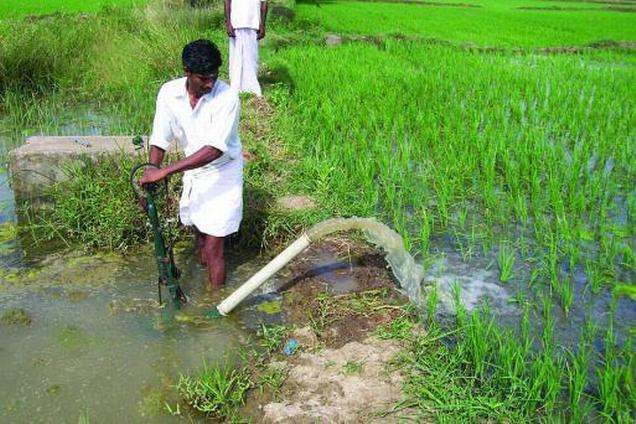
The breadbasket of India, the Cauvery Delta, requires that 400,000 acres of paddy be irrigated. This is an increase of 25% from last year. The remaining hundreds of thousands of acres (about one third of all acres under paddy) rely completely on traditional rain fed irrigation.

In addition to this literal climate crisis, heat is rising on the alawys politically charged cross state border release of dam reservoirs to satisfy dependent downstream farmers of the delta. The current reservoir readings do no foster confidence that both state's farmers will get their required quantum.3 Coupled with a weak rupee that has resulted in a near doubling of cost of chemical fertilizers (75% imported4) and this year is beginning to show signs of being the sum-of-all-fears.

PGI's perspective is that the monsoon remains viewed from polar positions – by those who mistakenly believe they are disconnected and view the monsoon as romantic or nostalgic; and those lower/bottom pyramid communities who rely on it for their annual revenue requirement just to subsist. The collision course can be avoided through cross sectional / cross cutting approaches to raising political and public awareness and action.
Drastic water conservation measures, emergency energy packages and CoOp organization of rural development interests must be deployed immediately otherwise a major climate crisis on the one hand; and a water resource management crisis on the other, is about to reach flashpoint. The shocks could have extreme consequences due to the sheer scale of population and lack of politico-social safety net. It's the 'resilience' building that UNEP, PGI and others have been advocating -urging developing countries to address. But still the entire national and international focus on 'the India economy' focuses on GDP, forex and market closing numbers, with a blissful unawareness of the connection.

Even for our U.S. readership, the event here are no far away concern. Even a cursory review of the effect of an irregular India monsoon, its effect on the Himalayan climatic cycle and stability, supports that systemic feedback loops are breaking down at alarming rates. We give thanks with our brother and sister colleagues in the NE India that the rains have been favorable - but even they- seem more concerned about the problems reported herein and the systemic approach that must be adopted. There are no regional crisis when it comes to climate change and shocks. We are seeing symptoms of a systemic illness. The time for a global land ethic is upon us that re-orients the roles of public - private, government and intergovernment resources toward a common service and repair of the natural feedback loops key to Earth -and our- survival.

Our energies and prayers are with all those gathering in Rio that a strong and committed plan of action be framed and implemented. PGI will be issuing press releases on Twitter from our representative to the UNGC Corp Sustainability Forum. Stay tuned.


1IMD June 15, 2012

2Tamil Nadu Farm Association

3Federation of Farmers in Cauvery Delta Districts, June 14, 2012

4Times India, June 13, 2012 Complex fertilizers increase 55%; reduced subsidy for non-urea fertilizer


Fair Use Notice: This post contains copyrighted material that has not been authorized by the copyright owners. PGI believes this educational use on the Green Eye Web-blog constitutes a fair use of the copyrighted material (as provided for in section 107 of the US Copyright Law.) If you wish to use this copyrighted material for purposes that go beyond fair use, you must obtain permission from the copyright owner. Fair Use notwithstanding we will immediately comply with any copyright owner who wants their material removed or modified or wants us to link to their web site which we routinely do as a business practice notwithstanding.

Tuesday, May 8, 2012

Hillary-Didi Touched the Hottest Topics: Energy Poverty/ Water Scarcity

Yes there was the standard push for FDI retail (bad idea for India growth) and outsourcing (good idea for US growth), but the true critical subject matter was mentioned as a basis point of creating sustainable economy with India's neighbors and evidence of the increasing reality that politics as usual will not carry us through the transplantation from conventional economy to sustainable. The issues of water and energy on the lips of Hillary and Didi, and on such a high profile platform is a bellweather of things to come.

Regarding water scarcity and conflict, Secretary Clinton said: "We have to do a better job of trying to find a win-win solution for everybody because the alternative will be perhaps worst than conflict, leading up to dislocation, destabilisation, refugee flows, famine and other kinds of problems that we are seeing in places like north Africa." "We have to work together in the international community," she said.

For perhaps the first time publically Clinton acknowledged what conservationists  and economists have been predicting for years: "... we know from working on our own projections what will be the hard issues in future unless water issues are properly dealt with,"

The reality is that there continues to be an ever shrinking bubble of economies that because of their uber-infrastructure remain able to maintain the status quo despite massive shifts in climate and natural resource security. In these economies, the conventional wisdom that technology has outgrown the need for nature and its resources, some going so far as to deny the very existence of a problem. And in fact, as is human nature, as long as the AC is running at home in office all seems well.

However, at the frontlines of climate change and sustainable economic development, a story is slowly unfolding and not carried by mainstream media. Throughout India, and specifically in the south, the story of India Inc. is changing complexion ... it's five minutes to midnight and Cinderella's coach is still out about town living a hapless dream. The two rents in this reality are a widespread power-poverty and a rapidly and potentially irreversible water security crisis. 

For those in India, this article only highlights the present reality and crisis for not only Bengal but throughout India...for those in the U.S. with a more limited world view of the coming escalation of power poverty, this may come as an eye opener of the new normal - in the cases illustrated below-in south India.

The question really becomes "Does the conventional definition of 'development' really apply in terms of the necessity for a sustainable economic and political model? Are we all therefore 'undeveloped' or 'under-developed' until these issues are rectified and power and basic necessities are sustainable?

 This year, city is hottest summer destination
A Selvaraj TNN

Chennai: It’s that time of the year when Chennaiites pack their bags to visit their native places in the state. But this summer they have chosen to stay put in the city; otherwise, it would mean jumping from the frying pan into the fire in the season of power cuts.
    Even while cursing the two-hour power cut in Chennai, residents take solace that it is much better than in some other districts, where power supply is disrupted for up to 12 hours a day. In fact, relatives from other parts of the state are thronging the homes of residents in the city.
   
 “My children never miss visiting their cousins in Salem but the moment I told them that there would be no electricity there, they wanted to cancel the tickets. I’ve asked my sister in Salem to come over with her family,” says Sudha Mani of Nanganallur.
 
   A Ponmani Thangam, an employee of Canara Bank in Tirunelveli, has come to Chennai to visit relatives and, well, get away from the “land of constant power cuts,” as she puts it.
    “At my place, we wake up early because of the heat. We are lucky to have power supply for an hour in the morning. We have an inverter, but the few hours of supply are not sufficient to charge it,” she says.
 
    Maheswari, a revenue department employee in Coimbatore, has gone a step further. “I have appealed to the higher officials in Chennai seeking a transfer to the state capital. My son can’t stand the heat,” she says. K Manikandan, a school teacher from Tuticorin, says he will spend a couple of weeks in Chennai, “where you at least know when there will be a power cut”.
 
   President of the Tamil Nadu Omni Bus Owners Association A Afzal says many buses from Chennai to other towns in the state are plying with at least 15% of unoccupied seats. “Usually our buses run full, but not this year,” he says.
 
    Many people who travelled to other parts of the state have got back before schedule.
  
 Summer travellers to hill stations, however, are happy. “People are asking for details of trips to Ooty and Kodaikanal,” says Afzal.
    selvaraj.a@timesgroup.com 
 

THE HEAT IS ON

Govt report sees 4 degree rise in temperature in 10 years

Nitin Sethi TNN


New Delhi:  If the freakish cool weather across India has lulled you into forgetting about the dangers of global warming, here’s a reality check. In a report to be submitted to the UN in a few days, the Indian government has said alarming climatic changes are taking place in the country and projected even more serious trends for the future — including a 4 degree Celsius rise in maximum temperatures in some parts as early as the 2020s.

    The report says that more than three out of four weather stations across India had witnessed an alarming rise in intensity of rains (over 24 hours) in the period between 1980-2009.

    It says intense warming was witnessed between 1998-2007 and the intensity has been rising since the 1970s. The mean temperature during winters have risen by 0.7 degree Celsius and post-monsoon mean temperatures by 0.52 degree Celsius in the last 100 years. The mean temperature in India rose by 0.2 degree Celsius every decade between 1971-2007 with minimum temperatures rising more than maximum temperatures, which increased 1.02 degree Celsius in 100 years. 

Number of rainy days on the decline: Report
New Delhi: In a report to be submitted to the UN in a few days, the Indian government has said alarming climatic changes are taking place in the country.
    While the trends show evidence of warming, there is, however, no conclusive proof that these are linked to human-induced climate change.     The most alarming findings in the report are the predictions it makes based on scenarios that greenhouse gas emissions would continue to rise unchecked over the coming decades.      Projections show that total monsoon rainfall could rise between 9-16% by the end of 21st century. By that time, annual mean temperatures could rise by 3.5-4.3 degree Celsius with 1.7-2 degree rise taking place as early as 2030s.      The report says the number of rainy days could decrease but 
rain could become more intense – thereby causing more damage – almost all across the country.

    Both the minimum and maximum temperatures recorded in a day will rise, according to the findings. Areas in Rajasthan and Kutch could see more than a 4-degree rise in maximum temperatures by as early as 2020s. A similar rise could take place in more than half the country by 2080.     Night temperatures are projected to rise by 4.5 degrees across a large part of the country by 2050 and the jump could spread to almost the entire country by 2080.     The frequency of cyclonic storms could decrease with time but the intensity with which they wreak havoc will rise, according to these simulation models.
    
Separate studies have been conducted to measure the impact of increasing GHG gases on water availability in river basins and on agricultural productivity. The government assessment notes, “Water scarcity levels will be crossed in Cauvery, Mahi, Sabarmati and westflowing rivers of Kuch, Sau and Luni, while Ganga, Tapi and Narmada basins will hit water stress limits.”

    The report says, “Ganga downstream, Brahmaputra and Surma-Imphal show high vulnerability to climate change in the northern and eastern basins.” Ganga upstream and Mahanadi will also become vulnerable by 2070, it says.
  
  Two different measures are used to quantify the net impact on water basins – the yield of water and the evapotranspiration from river basins. A majority of rivers show increasing precipitation, with exceptions such as Brahmaputra, Cauvery and Pennar.

Fair Use Notice: This post contains copyrighted material that has not been authorized by the copyright owners. PGI believes this educational use on the Green Eye Web-blog constitutes a fair use of the copyrighted material (as provided for in section 107 of the US Copyright Law.) If you wish to use this copyrighted material for purposes that go beyond fair use, you must obtain permission from the copyright owner. Fair Use notwithstanding we will immediately comply with any copyright owner who wants their material removed or modified or wants us to link to their web site which we routinely do as a business practice notwithstanding.