Search This Blog

Wednesday, August 7, 2013

CSR STATUS REPORT: SANCTUARY BELIZE, CENTRAL AMERICA: Defending a 3BL Paradise

Sanctuary: Forever Paradise A CSR Update from PGI President, Frank Costanzo-Connelly's in his role as the full time Sustainability Director of Sanctuary Belize, a 22 square mile Wildlife Reserve that inspires to allow a small percentage to be responsibly developed as a holistic sustainable community: Maintaining paradise during development requires business models that disrupt the conventional thinking that historically has led to paradise lost in so many other countries. Therefore, providing a quantifiable sustainability plan and actual deliverables is the most critical component to a development that prides itself on existing within a wildlife and watershed preserve. The most common question asked of nearly everyone is what quantum of the 14000 acres can be developed. This is a very valid question, however the better question -that usually follows during a longer course of discussion- is how that portion will be developed. That is, the measurement and management of sustainability. In short, quality. Eco Futures is so passionate and committed to achieving a showcase level of quality sustainability, that it branded what we are striving to achieve during development of Sanctuary Belize: the "five eco-lifestyles." It is simply, Forever Paradise. Much of my decision to accept the role as Sustainability Director was two prong authenticity: a large and unique biota with high biodiversity energy made up of five micro-climates; and an executive core team willing to give autonomy of planning and process to the role of a sustainability director to create and execute a genuine 'land ethic' plan of responsible development. The overarching goal of Five Eco-Lifestyles, as the name implies is development and community building that comes without a trade off of the Preserve's natural capital resources assets. If possible, in fact, developing infrastructures and programs that actually improve the natural and social community that extends to all life within the preserve, and embodies a land ethic. In essence to covet only the minimum footprint of natural capital that does not disrupt the biotic energy cycle, and to return in kind, measures that could further improve the strength of the biotic diversity through conservation and increased yield of natural capital assets. Plotting, planning, executing, measuring and managing these deliverables is the driver and mission crux. Here are a few of the infrastructures and programs that embody Forever Paradise: 1. Low impact, decentralized systems to deliver power, water and waste management. a) Power that is not only green, but carries an efficient levelized cost to install and maintain and where possible carbon and GHG negative. Using an objective mix of solar and biogas technologies based on the use, location and requirements allows Sanctuary to boast it's first ever government harvest and production concession to independently produce its own energy sourced from biomass waste collected directly from the property and proximate ag wastes. Using bioenergy to energize the beach club and tent village making it not only clean and green but also only beach in the Caribbean that's carbon footprint is negative?
Using solar energy on our prize pearl, Sanctuary Caye, to juice a world class water treatment and harvest system that provides irrigation and grey water. It will also energize a weather station that will provide valuable data to allow us to plan future infrastructure installations. And of course solar will 'juice' the blenders that turn out real juice for guests and residents desirous of a zero footprint Rum Punch. Our first solar powered cocktail. Further guests will be able to freshen up at the Caye with the convenience of modern 'self sustaining' restrooms amid lush Class 1 water fed gardens. Many thanks to Mark Mahaney, John and Chris Usher whose shared vision in the master planning for the island is bringing this about. Remember when we were kids and we could drink straight from the tap? Did you ever consider how we all allowed it to become 'norm' that safe water costs a buck and only comes in plastic bottles from South Pacific aquifers? Or that a billion dollar drinking-water filter industry became an acceptable alternative to keeping water clean in the first place? Or your brand water filter has become a status symbol of wellness? Well, Santuary Belize has the gift of a lake size aquifer that delivers ready to drink artesian waters that my sustainability plan jealously guards its use, with the intention that residents' great grandchildren will be drinking straight from the same tap. b) Redundant water delivery systems that are not intensive, well regulated and resilient to shocks such as power outages, intrusion or natural climate disturbances. The Quantity and Quality of water at Sanctuary is something we can boast by comparison to North Central and South American countries as well as globally. Four strategically located well naturally protected in the savanna ridge, have the flow rate to forever produce high quality, artesian spring water -ready to drink- to the entire development. This is without exception our penultimate responsibility as developers and the land ethic. Shifting and growing away from single line, energy intensive pumped water over miles of line, the (SB or SW) is currently undertaking the engineering task of spreading the load over the four wellheads. After extensive study and swot, it's been determined that above ground gravity towers are the most reliable and energy efficient method of providing on demand water. Going the extra mile to create a circuit water system provides security and well balance. Real time rainfall monitoring, water quality data and inline UV treatment provide source-to-tap quality assurance. We're excited to announce that this Fall we'll be pulling in some volunteer assets...mates from PGI's consultancy talent pool. We hope to be hosting world acclaimed FAO geologists and water resource management experts that have worked in areas of the world suffering water resilience crisis. Perhaps we can do like we did in Calcutta in 2010 and play host to a UNEP CSPAW convention. At any rate, these experts, will volunteer their vast consultative experience to deepening our understanding and resilience planning for our centerpiece savanna with its formidable ability to naturally process water into our natural aquifer.
A water sustainability plan and 'state of the Sanctuary water report' will be submitted to the organizing & transition board of the HOA, informing of the standards set forth by the Government of Belize, the best practices regarding cycling waste water for grey and irrigation and NTSB black water treatment, and futureproofing our systems to comply with the expected effluent levels for Caribbean Specially Protected Areas and Wildlife CSPAW standards. 2. Managing our waste flow is probably the single most challenging component of Forever Paradise. Nothing threatens our existence on Earth, and thereby Paradise more than management of our consumption and outputs. Whether you believe climate change is bunk, an Illuminati conspiracy or Gore should be beatified, global development has resulted in a resource burn rate that requires multiple Earths. Fact, as Johnny would stoically say. Gas solid and liquid wastes must be managed in an effective decentralized manner in order to limit the footprint of development. Low impact – no impact systems actually provide an opportunity to improve soil and water security through natural biotic cycles that return the productive nutrients and treated water back into the environment. This is not mere mimicking the natural biotic energy system but actually participating in it when living in a highly energetic ecosystem like Belize. a) Although population densities have yet to reach the level that economically support a centralized solids recycling and black waste water management, the futureproofing of Sanctuary requires we look over the horizon and explore the appropriate technologies for each. b) On the drawing board is tech'ing up the Sanctuary Caye infrastructure to accommodate more frequent visits by guests and owners. A showcase project that integrates water harvesting, solar primary/biodiesel backup energy and NTSE 40 international grade management of waste water. In essence we design and build onsite (using local professionals we've tech trained) micro waste water treatment facilities that rival municipal facilities and exceed international Class 1 water effluents. c) Could more traffic to Sanctuary Caye actually assist in developing an even more lush and sustainable micro-ecosystem? Yes. Wastes are treated and then up cycled to improve soil quality and increase plant access to invaluable fresh water. 3. Proactive investment into conservation and biodiversity and its appreciation through programs that support and promote same. Inclusion of the human hand into the landscape is something only recently realized as critical to sustainable wildlife management. This is the core of the land ethic and something the Sustainability Office is proactively inserting in all aspects of the development cycle from sales, CC&R's, HOA mission statement and a core fundamental of Adventurer's League. a) Green buffers, conservation areas, prescriptive lot clearing and landscape inputs following principles of biodiversity and permaculture. Staying abreast of best of breed development scale sustainability models, conservation and infrastructure is key. b) Currently we are producing manuals for builders and lot owners that clearly set forth the development standards as well as citations to the national and international criteria we are obliged to adhere. This manual is designed to cover the collective development as well as drill down into the discrete requirements of certain eco-lifestyle zones. ie. Riparian buffer along rivers; firebreaks along savanna; waste water discharge limitations along Class 1 and 2 waterways; density sensitive setbacks and natural flora removal regulation in the Waterway Villages. c) d) Currently we are producing a Standard Operations Manual for builders that will provide a definition to what it means to be a “Sanctuary Belize Approved Builder.” This gives the lot owner the comfort and security of knowing their builder meets a criteria that meets and adheres to the development, local and nation of Belize laws and Central Building Authority guidelines. 4. community building and cross community communion and development through relations, industry and opportunity to grow and learn from one another and together. Examples include: Lending our logistics and supply line expertise to lot owner Dr. Bayrock, a Rotarian from Canada, whose goal it is to land computers and sewing machines for the young adults at the Ladyville orphanage near Belize City. Engaging the Maya Cultural Preservation Foundation – just a few miles away- at our neighboring village Maya Center to teach and source the weave works that we will be using in the bamboo homes and architectural features we'll be building onsite. Our two bamboo models were sourced from Bamboo Living whose factory is in faraway Vietnam. Built in carbon offsets are lost due to long transportation. Preference for locally sourced materials and labor are lost. Albeit a great product, a different and evolved business model was available to make it so bamboo material was close sourced and technical skills could be transferred to the under-employed Mayan work force, and in particular women. These 'transfers of technical methods and systems (TOTEMS) have created direct and indirect jobs opportunities for a historically disenfranchised community. We'll be providing the machines and materials until the enterprise is itself sustainable. It's the kind of low risk entry into enterprise that promotes community engagement and was the signature work for PGI in India, Nepal and Arunachal. Making the SB/SRWR Office of Sustainability available and accessible to residents and guests during tours for consultation to the development, prescriptive lot assessments and to the greater community and as a good will ambassador and policy recommendations to the Govt of Belize. 5. Cross cutting is the top shelf of corporate sustainability sciences and practice. It's actually the core of the Forever Paradise brand and has already drawn international attention. Cross cutting is the ability to create business models on the principles of profit, planet and people. A really amazing thing happens when one purpose plans along these three lines... synergy. As if by some law of physics, triple bottom line enterprise models simply work better than conventional models. Recently this type of business planning has been given a name... disruptive entrepreneurship. Application of a broader definition of 'profit' is what creates the synergy that in essence 'disrupts' the conventional. The art of creating these kind of enterprises is akin to a yogic enlightenment (ok, y'all stick with me here) as you realize that businesses that participate in the biotic cycle are in essence super charged by it. In economic terminology... you can't beat my overheads and security on a fossil model. And what a great name to illustrate the point... 'my company's waste powers my factory and my workforce's community...what has your fossil model done for you lately?' Or my favorite... 'my workforce loves their job because they're community owns it.' The true blessing that embodies Sanctuary is the fact they have disrupted the norm and recognized that your investment in the land is a matter of quality. You'll hear Mr Johnny often refer to this as The Cause. The future proofed planned security for clean water – in juxtaposition to a world rife with water filter billionaires, creates value more so than the swanky amenities that adorn the waterways.
6. From the specimen tree to the no-touch zone around lots creates value. The prime disruptor, is someone whose life has been to do this type of work, and I am thankful for the carte blanche I have been given to write up a site plan guideline that defends, enhances and protects the three bottom line investment economics of Paradise Found. Again I thank Developer Eco Futures and the NGO Sittee River Wildlife Reserve, to allow my participation in such an exciting public private partnership undertaking. It's my firm belief that its authenticity will make it considered a world class three bottom line metric development, the value addition of which, will be a global showcase that demonstrates what can be achieved to protect natural resources while creating massive infrastructure efficiencies - via application of a land ethic. Mass duplication of the model is the ultimate goal. Fair Use Notice: This post contains copyrighted material that has not been authorized by the copyright owners. PGI believes this educational use on the Green Eye Web-blog constitutes a fair use of the copyrighted material (as provided for in section 107 of the US Copyright Law.) If you wish to use this copyrighted material for purposes that go beyond fair use, you must obtain permission from the copyright owner. Fair Use notwithstanding we will immediately comply with any copyright owner who wants their material removed or modified or wants us to link to their web site which we routinely do as a business practice notwithstanding.

Tuesday, October 16, 2012

Press Release: Limerick Goes The Mondragon Way: CoOp's making CoOps

October 15, 2012 (FPRC) -- Supported by Limerick City Council and Limerick County Council, the Limerick Workers Cooperative is being styled on the internationally successful Mondragón Cooperative Corporation in the Spanish Basque country, which has sustained over a quarter of a million jobs in spite of the ongoing recession. The new Cooperative will feature a combination of producer, consumer, worker and community co-ops in Limerick’s biomass, electricity and intensive commercial horticulture sectors.

Michael Noonan TD, Minister for Finance will officially launch the Limerick Workers Cooperative at a seminar at The Kemmy Business School in the University of Limerick on Saturday 27th October 2012.

Bill Kelly of Meitheal Mid West and the Workers Cooperative Network, which is coordinating the upcoming event, explained that the “Reinventing Limerick - The Cooperative Way” seminar will have two broad themes.

“Following on from last year’s visit to Limerick by the Mondragón Cooperative, we are inviting leading worker cooperatives from Britain and Ireland, both north and south, to tell their story of how they built their businesses. The second theme will focus on the launch of Limerick’s and Ireland’s first-multi stakeholder cooperative he stated.

Mr. Kelly explained that the development of the Limerick Workers Cooperative represents an innovative approach to developing business opportunities for new and existing businesses in the region.

“The purpose of this co-operative is to empower individuals and businesses in Limerick to work together and by doing so benefit from being part of a larger group. The evidence from other countries where cooperatives have been established show that such groups are more adept at climbing the value chain, engaging in R&D, and keeping jobs & wealth in their local communities. They also have more buying and bargaining power than individual members might ordinarily have. Industrial worker cooperatives are competitive, innovative and profitable business entities which are proved to be more resilient that conventional businesses in times of recession. This development is of particular local significance in light of recent figures from the Central Statistic Office (CSO) that confirm 7 of the country's 10 worst unemployment blackspots are in Limerick he added.

Mr. Kelly continued: “By working with the Workers Cooperative Network, setup in June 2012 to promote the interests of worker cooperatives across Ireland, the Limerick Workers Cooperative will look to expand its scope as its membership grows. This objective is made more achievable through the support of Limerick Local Authorities, a development which represents a new departure for Irish cooperatives which have normally been focused on individual business sectors.

Mr. Kelly said that through the establishment of the Limerick Workers Cooperative, the region had the opportunity to learn from and follow the lead of industrial cooperatives that have achieved international success from humble beginnings, such as the Mondragón Cooperative Corporation headquartered in the Spanish Basque country.

Established in 1955 through a coop of five workers assembling paraffin heaters, Mondragón is now the largest employer in the Basque country, employing more than 80,000 worker/owners in multiple areas including industry, banking and consumer sectors. There are also 14 research centres, vocational training and teaching centres, including a university that has 4,000 students.

According to Mr. Kelly: “In the midst of the current financial crisis, the Basque country continues to enjoy a higher credit rating than the Spanish sovereign. There is a 7.9% unemployment rate in the Basque Country compared to over 22% for Spain as a whole. 20% of Mondragón’s 2011 turnover is from products and services which didn’t exist five years ago, such is the quality of their high tech research & development and their consequent intellectual property. By establishing the Limerick Workers Cooperative in 2012, the United Nations International Year of Cooperatives (IYC), we are hoping to sow the seeds that will eventually see Limerick become a leader in the development of a cooperative-driven local economy focused on internationally traded goods & services.

Speaking ahead of the seminar Professor Fred Freundlich of the Mondragon University, part of the Mondragon Cooperative Corporation, stated: �Mondragon’s success has many components, not least of which is its commitment to innovation and the inter cooperation among its 120 cooperatives whether in the industrial, financial, retail or educational and R&D sectors. It is encouraging to see Meitheal Mid West and the Workers Cooperative Network pursuing the inter-cooperation idea themselves and developing it further with links with the cooperative family in Britain."

We wish Limerick well in their efforts to adapt the Mondragon model to their local circumstances and promote stable economic development through enterprises that are both economically successful and broadly socially beneficial. We hope Limericks efforts will be as rewarding for Limerick as the Cleveland Ohio efforts are for Cleveland - in the setting up of the Cleveland Evergreen Cooperative Group. Mondragon is also looking forward to participating in the Interreg “Cooperatives for Growth” bid being led by the new Limerick Local Authority and the University of Limerick," Professor Freundlich added.

Among the speakers at the upcoming day-long seminar at The Kemmy Business School will be representatives from British worker coops, environmental science instrument manufacture Delta-T Devices, international renewable energy pioneers Dulas Engineering, and Specialist Wholesaler The Suma Coop, The Unicorn Coop (Manchester’s Cooperative Grocery). Northern Ireland will be represented by The Belfast Cleaning Cooperative and The Northern Ireland Cooperative Forum, the regional body representing the interests of existing and emerging co-operatives in Northern Ireland. Other contributors include The Bridge Street Coop in Kenmare and Roscommon Home Services (RHS).

“Reinventing Limerick - The Cooperative Way” will be opened by Michael Noonan TD, Minister for Finance, at 10:30 am on 27th October 2012.

The seminar is open to anyone wishing to be involved in the development and ownership of Limerick’s cooperatives, or wishing to find out more about the cooperative movement (unemployed - graduates & non graduates are particularly welcome). The event is free but interested persons are requested to register in advance at the Workers Cooperative Network site, www.workerscooperativenetwork.org or email admin@workerscooperativenetwork.org.


CONTACTS:
Bill Kelly
Meitheal Mid West
+353 87 6474 230
+353 61 208 352

Mark Dunphy
Dunphy PR
+353 86 8534 900

Send an email to Mark Dunphy of Dunphy PR
00353868534900


Fair Use Notice: This post contains copyrighted material that has not been authorized by the copyright owners. PGI believes this educational use on the Green Eye Web-blog constitutes a fair use of the copyrighted material (as provided for in section 107 of the US Copyright Law.) If you wish to use this copyrighted material for purposes that go beyond fair use, you must obtain permission from the copyright owner. Fair Use notwithstanding we will immediately comply with any copyright owner who wants their material removed or modified or wants us to link to their web site which we routinely do as a business practice notwithstanding.

Tuesday, June 19, 2012

PRESS RELEASE: ARCHITECT DAVID SANDS of BAMBOO LIVING, STATEMENT AT RIO CIFOR 8th Roundtable on FORESTS


Frances Seymour, Director General                  
Center for International Forest Research
(CIFOR)
Sindangbarang, Bogor, 16115 Indonesia


His Royal Highness
The Prince of Wales’s Accounting for Sustainability Project
The International Integrated Reporting Council
The Green Economy Coalition and Stakeholder Forum


June 18, 2012

Dear Director General Seymour, et al:

Regrettably, I was unable to attend the 8th Forest Roundtable as planned due to circumstances outside my control. I cannot overemphasize the importance of the Roundtable's agenda. In my opinion there can be no discussion of sustainability unless it begins and ends with the conservation and management of our rapidly vanishing global forest resources. In particular, it was the one forum for which I humbly believed my voice carried weight, as I have the ability to say that I am the co-founder of a decade old global business that integrated the use of a historically handicraft raw material -bamboo- and engineered its natural properties into a high performance building material. Over the years, BT has found great value in the ability to market from the U.S. its developing-country Vietnam produced goods as ICC certified; and likewise agrees with CIFOR's position that similar indirect market mechanisms should be scaled up to support and promote demand side regulation for green commodities.

My company -Bamboo Technologies, LLC- is a significant example that 1) consumers will embrace new material buildings when they exude quality, perform and carry genuine green values; 2) that myriad three-bottom-line forest economies -based on non-timber forest product agroforestry- are a viable development model delivering healthy ecosystems and sustainable communities. Add to this REDD+ and a synergistic driver of genuine 3BL economic models is achievable. Coupled with integrated reporting metrics and CSR, the private sector would likely look favorably on finance for REDD+ (which according to CIFOR is an industry with a potential to deliver an additional US $13 billion in resources per annum by 2020.)

For BT, bamboo proved a high performance timber replacement material; a rapidly renewable; a carbon capture device, when caringly produced, can balance emission reduction goals with the well being of forest communities, including their participation, rights and knowledge. The principle of 'caring' production is very much an ethic that connects the raw material to forest to community to business to consumer. A new broadened stakeholder 'profit' paradigm. BT's experience has now led to the promotion of a hybrid cross cutting public private partnership model, that includes government concessional community forest cooperatives managed and monitored by regional and national NGO. This type of relationship building takes time, resources and insight, but it is the type of commitment required of transitional change, and is the check and balance security that private markets and REDD+ will and must require for transparency.

Finally, BT's research and experience has demonstrated that the treatment of forests as 'museums' that remove humankind from the forest natural econ-ecosystem is as unnatural as over-exploitation. A decade of experience and deep investigation of the critical 3BL objectives favor -and arguably cannot realistically exist without market mechanisms and a view that forest economy and products are the clear source of economic growth and poverty reduction for developing countries.

Respectfully Submitted,

/s/
David Elliott Sands
Co-Founder, Bamboo Technologies, LLC
a Rio+20 Forum representative of,
The Peerless Green Initiatives Network
a Global Compact Member

cc:

UNEP, TEEB
UNGC
His Royal Highness The Prince of Wales’s Accounting for Sustainability Project
The International Integrated Reporting Council
The Green Economy Coalition and Stakeholder Forum


Fair Use Notice: This post contains copyrighted material that has not been authorized by the copyright owners. PGI believes this educational use on the Green Eye Web-blog constitutes a fair use of the copyrighted material (as provided for in section 107 of the US Copyright Law.) If you wish to use this copyrighted material for purposes that go beyond fair use, you must obtain permission from the copyright owner. Fair Use notwithstanding we will immediately comply with any copyright owner who wants their material removed or modified or wants us to link to their web site which we routinely do as a business practice notwithstanding.

Thursday, June 14, 2012

Monsoon Betting: Climate Change Holds The Dice


The India SW monsoon thus far has demonstrated climate change does not affect systems uniformly. This fact presents a unique risk management challenge. The easterly extrusion of the monsoon's normal eastern front, weak cyclonic (and at times anti-cyclonic) winds, regionally varied rainfall that is net negative 50%+1 is compounded by poor infrastructure that is not able to cope even under the best of conditions. (500MW deficit power for pumps2; failure to recharge bore-wells; over-exploited water table; poor management of reservoirs, dams and allocation.)
 
Even a cursory review of the effect of an irregular India monsoon, its effect on the Himalayan climatic cycle and stability, supports that systemic feedback loops are breaking down at alarming rates.
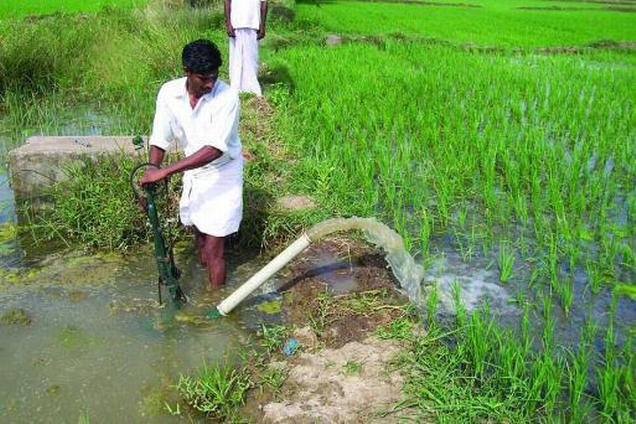
The breadbasket of India, the Cauvery Delta, requires that 400,000 acres of paddy be irrigated. This is an increase of 25% from last year. The remaining hundreds of thousands of acres (about one third of all acres under paddy) rely completely on traditional rain fed irrigation.

In addition to this literal climate crisis, heat is rising on the alawys politically charged cross state border release of dam reservoirs to satisfy dependent downstream farmers of the delta. The current reservoir readings do no foster confidence that both state's farmers will get their required quantum.3 Coupled with a weak rupee that has resulted in a near doubling of cost of chemical fertilizers (75% imported4) and this year is beginning to show signs of being the sum-of-all-fears.

PGI's perspective is that the monsoon remains viewed from polar positions – by those who mistakenly believe they are disconnected and view the monsoon as romantic or nostalgic; and those lower/bottom pyramid communities who rely on it for their annual revenue requirement just to subsist. The collision course can be avoided through cross sectional / cross cutting approaches to raising political and public awareness and action.
Drastic water conservation measures, emergency energy packages and CoOp organization of rural development interests must be deployed immediately otherwise a major climate crisis on the one hand; and a water resource management crisis on the other, is about to reach flashpoint. The shocks could have extreme consequences due to the sheer scale of population and lack of politico-social safety net. It's the 'resilience' building that UNEP, PGI and others have been advocating -urging developing countries to address. But still the entire national and international focus on 'the India economy' focuses on GDP, forex and market closing numbers, with a blissful unawareness of the connection.

Even for our U.S. readership, the event here are no far away concern. Even a cursory review of the effect of an irregular India monsoon, its effect on the Himalayan climatic cycle and stability, supports that systemic feedback loops are breaking down at alarming rates. We give thanks with our brother and sister colleagues in the NE India that the rains have been favorable - but even they- seem more concerned about the problems reported herein and the systemic approach that must be adopted. There are no regional crisis when it comes to climate change and shocks. We are seeing symptoms of a systemic illness. The time for a global land ethic is upon us that re-orients the roles of public - private, government and intergovernment resources toward a common service and repair of the natural feedback loops key to Earth -and our- survival.

Our energies and prayers are with all those gathering in Rio that a strong and committed plan of action be framed and implemented. PGI will be issuing press releases on Twitter from our representative to the UNGC Corp Sustainability Forum. Stay tuned.


1IMD June 15, 2012

2Tamil Nadu Farm Association

3Federation of Farmers in Cauvery Delta Districts, June 14, 2012

4Times India, June 13, 2012 Complex fertilizers increase 55%; reduced subsidy for non-urea fertilizer


Fair Use Notice: This post contains copyrighted material that has not been authorized by the copyright owners. PGI believes this educational use on the Green Eye Web-blog constitutes a fair use of the copyrighted material (as provided for in section 107 of the US Copyright Law.) If you wish to use this copyrighted material for purposes that go beyond fair use, you must obtain permission from the copyright owner. Fair Use notwithstanding we will immediately comply with any copyright owner who wants their material removed or modified or wants us to link to their web site which we routinely do as a business practice notwithstanding.

Saturday, June 2, 2012

Gaia & the Growing Tree Bridge to Tomorrow's Economics

Survival of the fittest was a horrid illulsion. It is the reality most of us have been convinced of from birth. Always in constant conflict with our innate knowledge -deep inside our DNA laid the truth that all economy is based on networked systems of shared consumption. The gaia. By contrast our inter-human economic affairs, as well as our perception of the 'purpose' of nature, has for several centuries been based on the murderous premise of survival of the fittest -

We now have finally come to realize that Gaia could not possibly have survived as a system based on a premise of competition, and that our previously flawed beliefs has so upset the relationship of harmonic systems, that we must drastically change our human economy to be in tune with
Gaia's. (And likely assist Her in paying off the deficit we have accumulated with her.) We have finally- and hopefully not too late- awoken to the fact that all relations whether they be inter-human or inter-gaia, must be based on the Universal model of shared economics. This is the essence of true natural order ... it is the biotic system that we now attempt to mimic...not just in how we plant our gardens, but in how we plan every organizations definition and mode of profits.

The change has come. The revolution is upon us. The living bridge has been woven. The new epoch has arrived as in the past - with great suddenness.  We are living in the metaphorical flood, and from the macro to the micro the markets, policy and business dealings smack of panic and desperation by those that refused to step aboard the Ark. 


Like the living tree bridge (http://thegreeneyeofpgi.blogspot.in/2010/11/living-bridges-of-assam.html) we must use our minds to arrange and intertwine and resources -human and natural- needed to usher in a new age of commerce that pays its dividends to all. We must expediently re-learn long forgotten wisdoms and innate knowlege of how to integrate and become a harmonic part of Gaia's systems of which we are all indivisible.

The previous epoch was an Age of Enlightenment wherein we evolved through cognizance that each individual was born possessed of inalienable rights. We're now crossing over to the second age wherein we've become cognizant that all things must be granted those same rights ... the Land Ethic. An Ethic that must permeate every one of our human functions and endeavors. A sort of natural license. Certain structures are forming and gaining tractions such as L3C 's and B corps and hybrid cooperatives. These are quantum leaps for any who has experience in such things.  Just as the UCC was the codification of centuries of merchantile custom and practice, so too must be the Land Ethic. It must be the enforceable right of Gaia as a stakeholder, and that of every transaction with Gaia, or human. Just as the Doctrine of Sovereign Immunity crumbled in the face of democratic governance, so has Gaia proven our doctrine of exploitive economics fails the test of moral reality.


Fair Use Notice: This post contains copyrighted material that has not been authorized by the copyright owners. PGI believes this educational use on the Green Eye Web-blog constitutes a fair use of the copyrighted material (as provided for in section 107 of the US Copyright Law.) If you wish to use this copyrighted material for purposes that go beyond fair use, you must obtain permission from the copyright owner. Fair Use notwithstanding we will immediately comply with any copyright owner who wants their material removed or modified or wants us to link to their web site which we routinely do as a business practice notwithstanding.

Tuesday, May 8, 2012

Hillary-Didi Touched the Hottest Topics: Energy Poverty/ Water Scarcity

Yes there was the standard push for FDI retail (bad idea for India growth) and outsourcing (good idea for US growth), but the true critical subject matter was mentioned as a basis point of creating sustainable economy with India's neighbors and evidence of the increasing reality that politics as usual will not carry us through the transplantation from conventional economy to sustainable. The issues of water and energy on the lips of Hillary and Didi, and on such a high profile platform is a bellweather of things to come.

Regarding water scarcity and conflict, Secretary Clinton said: "We have to do a better job of trying to find a win-win solution for everybody because the alternative will be perhaps worst than conflict, leading up to dislocation, destabilisation, refugee flows, famine and other kinds of problems that we are seeing in places like north Africa." "We have to work together in the international community," she said.

For perhaps the first time publically Clinton acknowledged what conservationists  and economists have been predicting for years: "... we know from working on our own projections what will be the hard issues in future unless water issues are properly dealt with,"

The reality is that there continues to be an ever shrinking bubble of economies that because of their uber-infrastructure remain able to maintain the status quo despite massive shifts in climate and natural resource security. In these economies, the conventional wisdom that technology has outgrown the need for nature and its resources, some going so far as to deny the very existence of a problem. And in fact, as is human nature, as long as the AC is running at home in office all seems well.

However, at the frontlines of climate change and sustainable economic development, a story is slowly unfolding and not carried by mainstream media. Throughout India, and specifically in the south, the story of India Inc. is changing complexion ... it's five minutes to midnight and Cinderella's coach is still out about town living a hapless dream. The two rents in this reality are a widespread power-poverty and a rapidly and potentially irreversible water security crisis. 

For those in India, this article only highlights the present reality and crisis for not only Bengal but throughout India...for those in the U.S. with a more limited world view of the coming escalation of power poverty, this may come as an eye opener of the new normal - in the cases illustrated below-in south India.

The question really becomes "Does the conventional definition of 'development' really apply in terms of the necessity for a sustainable economic and political model? Are we all therefore 'undeveloped' or 'under-developed' until these issues are rectified and power and basic necessities are sustainable?

 This year, city is hottest summer destination
A Selvaraj TNN

Chennai: It’s that time of the year when Chennaiites pack their bags to visit their native places in the state. But this summer they have chosen to stay put in the city; otherwise, it would mean jumping from the frying pan into the fire in the season of power cuts.
    Even while cursing the two-hour power cut in Chennai, residents take solace that it is much better than in some other districts, where power supply is disrupted for up to 12 hours a day. In fact, relatives from other parts of the state are thronging the homes of residents in the city.
   
 “My children never miss visiting their cousins in Salem but the moment I told them that there would be no electricity there, they wanted to cancel the tickets. I’ve asked my sister in Salem to come over with her family,” says Sudha Mani of Nanganallur.
 
   A Ponmani Thangam, an employee of Canara Bank in Tirunelveli, has come to Chennai to visit relatives and, well, get away from the “land of constant power cuts,” as she puts it.
    “At my place, we wake up early because of the heat. We are lucky to have power supply for an hour in the morning. We have an inverter, but the few hours of supply are not sufficient to charge it,” she says.
 
    Maheswari, a revenue department employee in Coimbatore, has gone a step further. “I have appealed to the higher officials in Chennai seeking a transfer to the state capital. My son can’t stand the heat,” she says. K Manikandan, a school teacher from Tuticorin, says he will spend a couple of weeks in Chennai, “where you at least know when there will be a power cut”.
 
   President of the Tamil Nadu Omni Bus Owners Association A Afzal says many buses from Chennai to other towns in the state are plying with at least 15% of unoccupied seats. “Usually our buses run full, but not this year,” he says.
 
    Many people who travelled to other parts of the state have got back before schedule.
  
 Summer travellers to hill stations, however, are happy. “People are asking for details of trips to Ooty and Kodaikanal,” says Afzal.
    selvaraj.a@timesgroup.com 
 

THE HEAT IS ON

Govt report sees 4 degree rise in temperature in 10 years

Nitin Sethi TNN


New Delhi:  If the freakish cool weather across India has lulled you into forgetting about the dangers of global warming, here’s a reality check. In a report to be submitted to the UN in a few days, the Indian government has said alarming climatic changes are taking place in the country and projected even more serious trends for the future — including a 4 degree Celsius rise in maximum temperatures in some parts as early as the 2020s.

    The report says that more than three out of four weather stations across India had witnessed an alarming rise in intensity of rains (over 24 hours) in the period between 1980-2009.

    It says intense warming was witnessed between 1998-2007 and the intensity has been rising since the 1970s. The mean temperature during winters have risen by 0.7 degree Celsius and post-monsoon mean temperatures by 0.52 degree Celsius in the last 100 years. The mean temperature in India rose by 0.2 degree Celsius every decade between 1971-2007 with minimum temperatures rising more than maximum temperatures, which increased 1.02 degree Celsius in 100 years. 

Number of rainy days on the decline: Report
New Delhi: In a report to be submitted to the UN in a few days, the Indian government has said alarming climatic changes are taking place in the country.
    While the trends show evidence of warming, there is, however, no conclusive proof that these are linked to human-induced climate change.     The most alarming findings in the report are the predictions it makes based on scenarios that greenhouse gas emissions would continue to rise unchecked over the coming decades.      Projections show that total monsoon rainfall could rise between 9-16% by the end of 21st century. By that time, annual mean temperatures could rise by 3.5-4.3 degree Celsius with 1.7-2 degree rise taking place as early as 2030s.      The report says the number of rainy days could decrease but 
rain could become more intense – thereby causing more damage – almost all across the country.

    Both the minimum and maximum temperatures recorded in a day will rise, according to the findings. Areas in Rajasthan and Kutch could see more than a 4-degree rise in maximum temperatures by as early as 2020s. A similar rise could take place in more than half the country by 2080.     Night temperatures are projected to rise by 4.5 degrees across a large part of the country by 2050 and the jump could spread to almost the entire country by 2080.     The frequency of cyclonic storms could decrease with time but the intensity with which they wreak havoc will rise, according to these simulation models.
    
Separate studies have been conducted to measure the impact of increasing GHG gases on water availability in river basins and on agricultural productivity. The government assessment notes, “Water scarcity levels will be crossed in Cauvery, Mahi, Sabarmati and westflowing rivers of Kuch, Sau and Luni, while Ganga, Tapi and Narmada basins will hit water stress limits.”

    The report says, “Ganga downstream, Brahmaputra and Surma-Imphal show high vulnerability to climate change in the northern and eastern basins.” Ganga upstream and Mahanadi will also become vulnerable by 2070, it says.
  
  Two different measures are used to quantify the net impact on water basins – the yield of water and the evapotranspiration from river basins. A majority of rivers show increasing precipitation, with exceptions such as Brahmaputra, Cauvery and Pennar.

Fair Use Notice: This post contains copyrighted material that has not been authorized by the copyright owners. PGI believes this educational use on the Green Eye Web-blog constitutes a fair use of the copyrighted material (as provided for in section 107 of the US Copyright Law.) If you wish to use this copyrighted material for purposes that go beyond fair use, you must obtain permission from the copyright owner. Fair Use notwithstanding we will immediately comply with any copyright owner who wants their material removed or modified or wants us to link to their web site which we routinely do as a business practice notwithstanding.

Saturday, May 5, 2012

THE SOLUTION: LEOPOLD'S LAND ETHIC

I see a world where every village great and small is a micronation of complete sustainability and economic freedom, linked to each other through technology and the undistorted language of a land ethic governed commerce. If you want a tomorrow for our children; if you genuinely want world peace, you will share in and bring about this vision.

- Frank Costanzo
Peerless Green Initiatives
November 2010, Kolkata, UNEP Seminar on Diversity Management of At-Risk Commercially Valuable Crops Through Community-Technology Integration

The notion that inalienable rights have national borders is over. The age of the political map is over.  We are entering is the next age of human enlightment. The geographic and human global map has demanded its due. We cannot carry on as we have because we know what's the inevitable outcome. It is now a question of morality.

- Frank Costanzo
Peerless Green Initiatives
March 2012, Statement for presentation at Rio+20


Published in 1949 as the finale to A Sand County Almanac, Leopold’s ‘Land Ethic’ defined a new relationship between people and nature and set the stage for the modern conservation movement. Leopold understood that ethics direct individuals to cooperate with each other for the mutual benefit of all. One of his philosophical achievements was the
idea that this ‘community’ should be enlarged to include non-human elements such as soils, waters, plants, and animals, “or collectively: the land.”

“That land is a community is the basic concept of ecology, but that land is to be loved and respected is an extension of ethics.”

This recognition, according to Leopold, implies individuals play an important role in protecting and preserving the health of this expanded definition of a community.

“A land ethic, then, reflects the existence of an ecological conscience, and this in turn reflects a conviction of individual responsibility for the health of land.”

Central to Leopold’s philosophy is the assertion to “quit thinking about decent land use as solely an economic problem.” While recognizing the influence economics have on decisions, Leopold understood that ultimately, our economic well being could not be separated from the well being of our environment. Therefore, he believed it was critical that people have a close personal connection to the land.

“We can be ethical only in relation to something we can see, feel, understand,
love, or otherwise have faith in.”


     Leopold’s Land Ethic

     What Are Ethics?

People tend to use the term ethics in two different ways.
Ethics help us decide how we ought to live. In their most general form, we might say that ethics are the standards we employ (among other factors) to determine our actions. They are prescriptive in that they tell us what we should or ought to do and which values we should or ought to hold. They also help us evaluate whether something is good or bad, right or wrong. 

Leopold’s example: “A land ethic changes the role of Homo sapiens from conqueror of the land
community to plain member and citizen of it…it implies respect for his fellow-members, and also
respect for the community as such.”

Ethics explain why things are important to us. Ethics are also concerned with how and why we value certain things and what actions properly reflect those values. In this sense, ethics appear more descriptive. Just as it is possible for taste to be a neutral and descriptive term –appreciation for a work of art can be a matter of taste – ethics can operate the same way. 

Leopold’s example: “Sometimes in June, when I see unearned dividends of dew hung on every
lupine, I have doubts about the real poverty of the sands…do economists know about lupines?”


“The land ethic simply enlarges the boundaries of the 
community to include 
soils, waters, plants, 
and animals, or collectively: the land.”
                                         - ALDO LEOPOLD


Reprint from The Aldo Leopold Foundation http://www.aldoleopold.org/AldoLeopold/leopold_bio.shtml

Fair Use Notice: This post contains copyrighted material that has not been authorized by the copyright owners. PGI believes this educational use on the Green Eye Web-blog constitutes a fair use of the copyrighted material (as provided for in section 107 of the US Copyright Law.) If you wish to use this copyrighted material for purposes that go beyond fair use, you must obtain permission from the copyright owner. Fair Use notwithstanding we will immediately comply with any copyright owner who wants their material removed or modified or wants us to link to their web site which we routinely do as a business practice notwithstanding.

Friday, April 20, 2012

PRESS RELEASE: WBO: KEYNOTE SPEECH by BAMBOO ICONOCLAST: DAVID SANDS, AIA LEED AP

PRESS RELEASE:

THE FUTURE OF BAMBOO CONSTRUCTION

What We Need to Do Now

By David E. Sands, AIA LEED AP

In the midst of a recession there has and continues to be a green construction boom. Sales of green homes in the US has continued to rise when conventional construction has been flat. The opportunity for the growth of bamboo construction has never been better. There are a number of actions that need to be taken for bamboo to fulfill its potential as a building material in Europe, the US and other developed countries. The first is taking leadership in education as to why bamboo should be used for construction. This is particularly true in Europe and the US where there is no history of bamboo construction. The primary educational focus should be on the protection of native forests, and on the reduced need for mining to produce steel and concrete that the increased use of bamboo for construction affords.

The focus of the green standards for construction that have been developed has been mainly on energy conservation. In the US 90% of the energy used during the life of a building is from operations. However the materials used in a building have a much greater environmental footprint than simply the energy used for production and placement. Steel and concrete are both extractive industries and the use of wood for construction results in deforestation. At the same time to expand the use of bamboo beyond tropical areas it is very important to design for minimum energy use over the life of the buildings as exemplified by the Passivhaus Institut in Germany and the work of Zeri in Scandanavia. Our goal should be to create buildings which produce more energy than they consume.

For each acre of bamboo properly put into production for construction material many acres of trees can be taken out of production, eliminating the loss of cover and the erosion that would have been associated with the harvesting of those trees. When the avoided deforestation is taken into account the carbon stored by building with bamboo is effectively nearly doubled. More research is needed but the case can and should be made for using bamboo to address the most pressing issue of our time – global climate change. In the World Bamboo Congress in Bangkok I presented a strategy for using bamboo for carbon sequestration. In the educational process, there is no substitute for direct personal experience, in this case for being able to visit a bamboo building. This leads to the second action needed which is establishing model projects. 

The Hanover pavilion produced by Zeri and designed by SimonVelez is a good example and there are others in Europe already. My company, Bamboo Living, was able to build in the US prior to the completion of our national building code standard by working with local building officials. We brought Dr. Jules Janssen from Eindhoven University in the Netherlands to Hawaii to educate the local building officials about bamboo construction. Also as we completed each step in developing the standard we provided the latest information to the local building officials to review and provide feedback. This was essential to the development of our ICC standard as ICC wanted data from engineers working with the material. It also allowed us to generate the funds needed for the building code standard which took us seven years and significant expense to complete. Perhaps a similar approach can be taken for Europe through a creative collaboration between the public and private sectors and interested universities. Our team is certainly interested in being part of such an effort. From my perspective the first step is to find the client who is willing to be the pioneer. This leads us to the next issue of understanding who will buy bamboo buildings. Unless there is a market and that market is developed bamboo construction remains only a nice idea. In the US we have found that the people interested in building with bamboo tend to be from the group defined as the “cultural creatives” and as the LOHAS consumers. They are highly educated and values driven. 

To grow the bamboo construction opportunity in Europe, as we have been doing in the US, the considerations of this group of people need to be addressed. Their considerations revolve around the values that drive them. They care about the environment and social justice. How can they be assured that they are buying a green product? There is an apt analogy with the growth of the organic industry in the US and Europe. What was needed in the US to take organic food into the mainstream was the development of an organic standard that the buyer could feel assured met their personal standard. The development of the USDA Organic label was that necessary step. We could similarly establish a standard for bamboo that assured environmental principles were upheld in the growth, harvesting and manufacturing and that fair trade practices were adhered to throughout the supply chain. Glues and finishes should meet stepped goals for both performance and “greenness” similar to the CAFE standards used in the US to promote ingenuity with regard to environmental performance in the automobile industry. Sadly, organic food in the US is often associated with elitism. A goal of the bamboo construction industry has to be democratization. Bamboo should be not only the preferred environmental alternative but also the affordable alternative to conventional construction. This will need to come through scaling and new product development both of which we have been working on assiduously.

An additional consideration for Europe that needs to be addressed is that the climate of much of Europe is not conducive to the commercial cultivation of bamboo. This means shipping bamboo to Europe from other places. Shipping then becomes part of the environmental equation when considering bamboo for construction. A study done at Eindhoven University considered bamboo from Central America as opposed to steel, concrete and two types of sustainably grown wood for a bridge construction project. Even with the shipping between hemispheres bamboo had a much lower embodied energy than the other building materials. Further research and education of the public is needed along this line. Bamboo could become an alternative to extractive industries as an export for developing African countries. A consideration we often face in the US is a perception that bamboo is invasive. We educate our potential clients about the difference between monopodial and sympodial bamboos (runners and clumpers) and we have stuck with clumping species for our supply. If a monopodial is being used then a proper management plan has to be implemented and the public educated about it.

For bamboo construction to be widely accepted new products need to be developed that meet developed country standards for construction durability, performance and appearance. This can come in the creative use of poles and in the development of engineered bamboo products. We have gathered a think tank of global leaders and formed a new company, Bamboo Intelligence Global, to implement the technologies and strategies we have been developing. As a company we are pursuing an integrative approach that benefits all stakeholders from farmers to homeowners and look forward to sharing more about our efforts in the future. Our website is www.bamboointelgobal.com. Please join us in our efforts.

There are a number of opportunities for further research regarding bamboo construction. In loading tests done at IIT in Delhi, unlike steel and concrete, bamboo did not fail catastrophically. This could be a valuable area for further research as it defines the value of bamboo for construction in earthquake prone areas. Also with proper fireproofing the use of bamboo could be significantly expanded to compete with steel and concrete in midrise construction applications. For example we have been working with one technology that
encases bamboo in a cold ceramic.

Bamboo for construction is close approaching a tipping point. We have been seeing that in the US and I believe it is true for Europe as well. It will be through the concerted efforts of the people here and others like you that we can reach that point soon and begin to maximize the potential for bamboo in construction. This is a wonderful game where everyone wins including our beautiful little Earth. Let’s win this one for our home planet.


Fair Use Notice: This post contains copyrighted material that has not been authorized by the copyright owners. PGI believes this educational use on the Green Eye Web-blog constitutes a fair use of the copyrighted material (as provided for in section 107 of the US Copyright Law.) If you wish to use this copyrighted material for purposes that go beyond fair use, you must obtain permission from the copyright owner. Fair Use notwithstanding we will immediately comply with any copyright owner who wants their material removed or modified or wants us to link to their web site which we routinely do as a business practice notwithstanding.

Wednesday, April 11, 2012

Things you can learn Riding an India Metro Bus: Gender Bias & Development: The Importance of Swag Regressive Econometrics


Regression analysis is a statistical tool for the investigation of relationships
between variables. Usually, the investigator seeks to ascertain  the causal
effect of one variable upon another. To explore such issues,
the investigator assembles data on the underlying variables of interest and employs regression to estimate the quantitative effect of the causal variables upon the variable that they influence. The investigator also typically assesses the “statistical significance” of the estimated relationships, that is, the degree of confidence that the true relationship is close to the estimated relationship.
We have all heard the well worn phrase that India ... 'land of contradictions.' The more accurate is that it is a land of multidictions. Some of the best and worst examples of society's compassion and lack thereof occur everyday, in every corner of India. It is a target rich environment for any CSR professional or 3BL designer. It is a society that on one hand traditionally reveres nature and humankind, and on the other contains inhumane and deeply seeded abusive conventions re same. The business environment with its decade of meteoric rising development, complete with an all-costs fixation on breaking 10% annual GDP, has reflected moments of innovative and 'deep-ethic' CSR, but moreover resulted in an overall strategic disregard for basic human and natural capital resources and services. Although the government and policy is often blamed and complicit, it ultimately comes down to the failures of the business ethic that drives the economic growth we (perhaps mistakenly) call 'growth and development.'  In this extreme environment, where so much is in need of improvement, PGI formed its ethos and gained unparalleled expertise and vision. In honor of our own fifth year as a network organization, we will focus on some of the critical philosophies our our mission statement. Starting with the two most critical: Woman Equality and Energy Poverty. They are far more entwined than you may think.


In this installment we reflect on the art of paying attention. As 3BL planners and CSR professionals we must be accustom to becoming sensitive to the econometrics of various factors in the environment. Sometimes rapid societal changes can be explained by hidden macro shocks. This requires the use of active attentive regressive analytics. Practicing this as much and as often as possible makes ones forensic skills greater and thus a better 3BL designer.

Genuine 3BL and CSR requires critical analysis but it requires a curiosity for causation. Not always having the time or resources to engage an empirical study, an objective swag analysis of known factors should be employed. Standard regressive analytics such as participatory GIS is a tool that allows the professional to keep their eye on the ball so not to miss the story that is unfolding all around. It is something that the founders of PGI have made part of the business model and its business ethic. For example, Sand County Almanac is required reading for our new consultants and network members. (It's best read while traversing the ECR, the 'King's Highway' in Upper Assam and sitting standstill in India's Big 6 urban traffic.) We must always take a look around to remember what's at stake and what's important. It is this constant reading and quest that has continually honed our consultancy. Our goal is to follow the CSR need, and combat lip-servicing greed. This premise collectively led us to organically focus our 3BL business models and led us to pro-woman-Co-Op-ag-business, food security, land ethic CSR and most recently the realization that nearly everything from gender inequality to social-education gaps can be traced to energy poverty. Sounds strange but its undeniably true.

It's all too much to distill into one installment, and frankly we enjoy much more putting our models into practice on the ground than speaking in platitudes. But what can be said as we rapidly approach our fifth anniversary (and Rio+20 is that 'it works'. There is another way. 3BL is real. We have been to the promised land and we have seen lives transformed because of our models performing to spec in India. We have met some of the most inspirational people the world has to offer, and we are positive the green revolution will be won or lost based on the weight of India's minds. This is no exaggeration. This is not a statement made to curry favor of Indian readers. This is true whether you are in Paris, France, Paris Texas or Parrys Corner, Chennai.   India is huge and growing. I am not speaking in terms of economic prowess. I am talking about weight of consumption, weight of waste, weight of energy required to maintain its status quo.

The traditional attachment that is core to the traditional Indian and vedic ethic is the Land Ethic that Leopold and Steiner tried to implement in their day. Neither had such a following as they do now. They are notably unheard of in India, which is ironic in the case of Steiner.  Decades later and just now realizing they were right and we nonetheless remain on the same road to perdition.  Ufortunately the weight of minds in India have likewise ignored the sage advice of tradition and harmonics in favor of the same hollow promises of the consumerist economy. But this time, on the mind bending scale of a consumer base of 1+ billion, the thought of which leaves MNCs breathless in anticipation and the rest of us facing the grim reality of being drown in a mountain of disposable razors. Be sure that the first to suffer will be and always are the women and children, who due to inequality and malnourishment are the first victims of everything from rising petrol prices to newly minted drug resistant viruses.

This critical component of what makes us human has probably never been written about more succinctly and beautifully as the legal writing of Justice Rubello of Bombay High Court as he addressed the complexity and contradiction of adoption law in India. He found the single citation that sums up our present status as a human race:

We are guilty of many errors and faults
but our worst crime
is abandoning the children,
neglecting the fountain of life.

Many of the things we need can wait.
The child cannot.

Right now is the time his bones are being formed,
his blood is being made,
and his senses are being developed.

To him we cannot answer “Tomorrow”

His name is “Today.”

-Gabriella Mistral


So how can the subject of human ethics and our inalienable obligation as CSR professionals be answered on a bus. Well, it will comes as no surprise to anyone who knows me well that I noticed something interesting on the bus1 today. Something telling as it relates to social adjustment to shocks, and something about dealing with statistics in India.


For years I've daily taken the 21D bus to PGI's Parrys, Madras office. Through my western eyes it looks like something from Clint Eastwood's The Gauntlet, but that bucket of Ashok Leyland bolts charges up and down Marina Drive daily like a champ. Inefficient, dirty, rugged, used and abused are some good descriptors of 21D. She sits 48 and the Tamil board at the front of the bus says 24 can stand so 72 is supposedly her max...her 100%. Of this 100% the gender split is 60% women/40% men. Of the women, most are in school uniforms or get off at the half dozen centenarian universities along Marina Boulevard. This always made me feel good that our future may end up in the hands of these young ladies. Alas, if so, there's still hope for the human race.


Things happen in India in waves. Opinion and social habit moves in similar fashion and because of the sheer number of citizens, in spectacular fashion. When the bus fair doubled a few months back, the bus operated at 80% occupancy...I assume as some form of protest...or perhaps while the usual occupants checked out light rail, bike-pooling or otherwise breaking out the calculator to figure out efficiency ratios. (Indians love to do these kind of calculations from top to grass roots, which is part of their innate cultural sustainability ethic.) Eventually within a week 21D came back to 100% occupancy, for reasons I can only fondly speculate.

Last week, petrol was notched up 3 more rupees, the third hike in six months and reports now have India petrol (gasoline) prices as the highest in the world bar none. http://www.mypetrolprice.com/petrol-price-chart.aspx 

This, in a country where the middle income household GDP can be less than a lakh ($2000) per annum or at the opposite end of the spectrum, in league with the top billionaires in the world. For India's huge 400 million and growing 'middle class' three more rupees per liter, on increasingly crowded roads, hits the household economic equation rather hard. Particularly in light of the number of dual income families that have come into being over the past four or five years.

So to my point, since the petrol hike 21D has been operating at a very uncomfortable 120% occupants. I could write an entire installment on what that extra 20% does economically to the public transport system infrastructure and efficiency, but there is something far more important to note. Here it is:

The gender split is now 40% men and 80% women. Yes, in India, most things do not sum neatly into 100%. If you come to India to do business and do not understand this, then either don't come, or better yet (ha) call PGI.

So here;s the SWAG: The extra 20%, (after a quick toe ring count) are married working women, (and a quick sari fabric check) middle to upper middle class. They are the set that has to now been seen tooling to and from work on a variety of shiny 'scooty' mopeds. (The new symbol of India's development, the two motorized bike family.)  

So what can be gathered with (less than scientific) common sense logic is that there has been a shock (price of petrol increase is the obvious one), that some household adjustment had to be made (decrease weekly household petrol consumption cost) and the woman has been 'elected' to absorb the shock. Whether it can be seen as a positive (more humans taking public transport) pales in comparison with the more disturbing and continuing trend of women being the sacrificial lamb of economic and ecologic shocks. I use the bus example as an example of paying attention to the world in the way that we must, and testament to the many shocks that societies absorb that lead societies to shift behavior. The troubling part is that the absorption and shifts are seldom if ever equal.

The male of the species assures that the female and child is the buffer in order to preserve the male 'standard of living'. If anyone would like to debate this, I'd warn that I and others at PGI have a mental inventory of first hand examples that make this bus exercise trite. Horrific and inhumane examples of shocks resulting in women and children being thrown into the abyss in the name of 'development' and social 'integrity.' The status of the gender is no doubt improving and recent laws that give women rights to alimony in divorce and abandonment cases are long overdue but welcome. Today's times of India reported that the mother-not the father- is the priority and first named in guardianship cases. (This is dear to me personally, as I had to insist to my advocate and Court that my wife's name be included in the pleadings for the adoption of our son.)


In fact, professionally, we at PGI advocate that development that is not sustainable and 3BL is not development. The 'developed' world is developed on a myth that is proving itself an illusion. The transitioning world is not developing unless if follows a new model and create a new inalienable ethical and equality based delivery system of development. And for PGI and our network, we have come to use the woman and the child as the measure of sustainability in the environment. When the land-human-gender factors are all in balance, then and only then can we ascribe the model is healthy. The testament of same is reflected in the smile and confident twinkle of a mother's eye and the glow of her healthy children.

We looking forward to seeing you all in Rio in June so we can share and shape a vision for the future through economic models that make sense and accounts for every stakeholder no matter the strength of voice to demand a share.

-Frank Costanzo
Peerless Green Initiatives
1At PGI we ask that all our network members use the public transportation system where-ever available. Some of us including myself have converted our automobiles to LPG and are attempting to do some CSR for organizing a recycled cooking fuel and bio-gas filling station for diesel and CBG respectively. The interesting co-benefit of public transport is that it gets us closer to the social ground and infrastructure requirements where shocks are better felt than in the AC confines of our comfy cars and homes.

Fair Use Notice: This post contains copyrighted material that has not been authorized by the copyright owners. PGI believes this educational use on the Green Eye Web-blog constitutes a fair use of the copyrighted material (as provided for in section 107 of the US Copyright Law.) If you wish to use this copyrighted material for purposes that go beyond fair use, you must obtain permission from the copyright owner. Fair Use notwithstanding we will immediately comply with any copyright owner who wants their material removed or modified or wants us to link to their web site which we routinely do as a business practice notwithstanding.